Many small-to-medium CNC shops still rely on barcode scans, whiteboards, and operator notes to track work-in-progress. This article compares IoT sensors vs manual scanning WIP delays and shows how sensor-driven event capture reduces latency, improves cycle-time accuracy, and frees operators from repetitive logging—so throughput increases without new hires. Readers will get concrete metrics, a pilot roadmap, ROI examples, and security and integration checklists to move from manual scans to a sensor-first WIP tracking approach.
TL;DR:
-
Sensor capture reduces update latency from hours to seconds, cutting average WIP queue time by 10–30 minutes per job in typical pilots.
-
A 4–8 week pilot that compares sensor traces with manual logs yields validated cycle times and often recovers 5–15% more capacity without hiring.
-
Start with one bottleneck cell, aim for >95% detection accuracy, and connect sensor events to ERP/MES status changes to eliminate manual steps.
IoT sensors vs manual scanning: Why WIP delays still happen on the production line
A common small CNC shop uses barcode scans at load/unload, a whiteboard for queue order, and operator-entered timestamps in the ERP. That workflow creates predictable gaps: scan-to-scan latency often ranges from several minutes to multiple hours because operators prioritize machine setup and parts handling over data entry. Sample operator touch time per part for a scan-and-log routine is typically 30–120 seconds; multiply that by hundreds of parts per week and the labor adds up. Manual entry error rates of 1–5% are commonly reported in manufacturing operations studies and lead to inaccurate WIP counts and missed commit dates.
Consequences are concrete: inaccurate WIP counts raise apparent lead times, planners overbook capacity, and shop-floor dispatchers chase phantom jobs. Production metrics such as OEE and on-time delivery suffer; planners often allocate whiteboard time to fix mismatches instead of optimizing throughput. Research-oriented sources like the Bureau of Labor Statistics show manufacturing productivity and staffing pressures that make extracting hidden capacity from existing staff attractive. The short answer: manual scanning slows information flow, introduces human error, and inflates WIP levels—creating delays that sensor-driven, event-based tracking is designed to eliminate.
IoT sensors vs manual scanning: How IoT sensors capture real-time machine and WIP states (video embed)
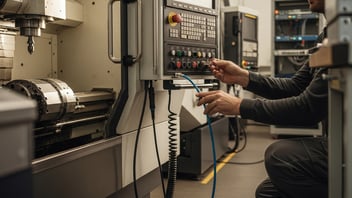
IoT sensors detect physical machine and process signals and translate them into discrete WIP events: run, cycle complete, load/unload, or idle. Typical sensor types used on CNC machines include:
-
Current/amp clamps and VFD current sensors to detect when a spindle or axis motor draws run current.
-
Spindle load and vibration sensors for distinguishing cutting from air-cutting or light-load periods.
-
Proximity or part-present sensors on conveyors and bins to detect part transfers.
-
Door or safety-switch sensors to mark the start or end of manual load/unload operations.
Edge gateways sit between sensors and cloud/onsite servers. They perform event filtering and debouncing (to avoid false spikes), aggregate short-term traces into meaningful events, and map those events to WIP states such as "in process", "waiting for unload", or "completed". Typical sensor latency for event detection is measured in seconds; many deployments stream data at 1–60 second granularity. False-positive rates vary by sensor and mounting but are usually under 5% with correct tuning. Standards and protocols commonly used across shops include MTConnect, OPC-UA, MQTT, and Modbus for transporting machine and sensor data—these make integration with monitoring and MES platforms straightforward.
For a short visual demo of sensors attached to CNC machines, edge event mapping, and a live dashboard, watch this example installation and mapping workflow: .
For software-first guidance on turning sensor data into actionable production signals, see the CNC monitoring software best practices that explain event mapping, dashboards, and alerts. CNC monitoring software
(external links: OPC UA, MQTT)
-
OPC Foundation on OPC UA: https://opcfoundation.org/about/opc-technologies/opc-ua/
-
MQTT project information: https://mqtt.org/
IoT sensors vs manual scanning: Accuracy, latency and capturing standard/cycle times (with comparison table)
Sensor-derived time series provide a fundamentally different kind of trace than manual timestamps. Sensors give second-level granularity and continuous coverage; manual scans are sparse and biased by operator availability. That changes how cycle and standard times are captured and how planners build schedules.
How sensor-derived cycle times differ from operator-timed standards
Sensor traces let engineers calculate:
-
Actual cycle time (door close to door open or spindle-on to spindle-off) with per-second timestamps.
-
Effective cutting time using spindle load or vibration signatures.
-
Wait time between jobs as measurable idle periods.
Manual timings typically capture start/stop points during operator interactions. They miss unattended cycles (e.g., lights-out runs), undercount short cycles, and inflate variance because operators batch scans or enter times at shift end.
| Metric | Manual scanning | IoT sensors |
|---|---|---|
| Detection latency | Minutes to hours | Seconds |
| Timestamp accuracy | ± seconds to minutes (dependent) | ± milliseconds to seconds |
| Granularity | Per-event (scan) only | Continuous (1–60s samples) |
| Labor overhead per event | 30–120 seconds/operator | 0 seconds (automated) |
| Record completeness | Missed events common | Near-complete with 90–99% coverage |
| Auditability | Manual logs, editable | Immutable time-series and audit logs |
| Typical error sources | Typos, missed scans, batch entry | Noisy signals, incorrect mapping |
When converting sensor traces to standard cycle times, a practical approach is to apply rules such as "spindle current > threshold for >5s = cutting" and "gap >120s = job finished". Example: for a job with 15 cycles/day, sensors show mean cycle = 5m 20s (std dev 30s) vs manual logs showing mean 5m 40s (std dev 2m). Manual scanning inflates variance by capturing batch entries or missing short cycles.
Sensors also enable automated downtime detection that captures short stalls and micro-stops often unreported in manual logs. For technical details on detecting downtime from sensor traces, see our guide to automated downtime detection. automated downtime detection
IoT sensors vs manual scanning: How reducing manual touchpoints lowers operator workload and WIP delays
Operators in small shops perform many small tasks: setup, fixturing, QC checks, moving parts, and data entry. Manual scanning creates context switches. Studies show a single interruption can take several minutes to recover from; frequent scans multiply that cost. For example, a 10-machine cell with manual scans averaging 3 scans per job at 60 seconds per scan produces 30 minutes of aggregated scanning per shift for one operator handling that cell.
Quantifying operator interventions and their impact on throughput
A sample operator task breakdown for an 8-hour shift might look like:
-
40% Machine-related tasks (setup, adjustments)
-
25% Part handling (load/unload, inspection)
-
15% Administrative tasks (scanning, logging)
-
20% Waiting/idle or problem solving
Removing scanning reduces administrative time and minimizes interruptions. In practice, many shops report a 40–70% reduction in operator touchpoints on WIP tracking after adding sensors, freeing time for higher-value activities such as QC or additional setups.
Understand what is really happening on your shop floor
Monitor your CNC machines in real time and capture cycle times, downtime events, and production activity.
Explore machine monitoring →
Workflows redesigned: from scan-and-log to event-driven alerts
Sensor events power event-driven workflows:
-
Automatic job-complete triggers update ERP/MES work order status.
-
Alerts are sent only when exceptions occur (stalled job, no unload after X minutes).
-
Operators receive simple actions on mobile or kiosk instead of filling forms.
Connected worker tools complement sensors by handling the operator-facing bits. For guidance on combining sensors with operator workflows, see our connected worker recommendations. connected worker solutions
Key points: what to measure first
-
Operator interventions per hour: baseline number of manual scans or logs.
-
Mean time between updates: average time ERP sees progress updates.
-
Manual corrections per week: count of times planning team edits orders after shift.
-
Detection accuracy target: aim for >95% event match between sensor and manual logs during pilot.
For a practical checklist to cut operator touchpoints, see the reduce manual interventions checklist. reduce manual interventions
IoT sensors vs manual scanning: Step-by-step transition plan for small-to-medium CNC shops
Moving from manual scanning to a sensor-first WIP system is best done in small, measurable steps. The following 6-step plan is pragmatic and low-risk.
-
Identify pilot scope: choose a bottleneck cell or high-volume part family with steady cycle patterns.
-
Baseline metrics: capture current manual scan latency, number of scans per job, and error rates for 2–4 weeks.
-
Select sensors: pick 1–2 sensor types (e.g., amp clamp and door switch) and one integration point (MQTT or OPC-UA).
-
Deploy pilot hardware: install sensors, connect edge gateway, and run both sensor capture and manual scans in parallel for 4–8 weeks.
-
Validate mapping: compare sensor events to manual logs and refine thresholds and debounce rules until detection accuracy >95%.
-
Integrate with ERP/MES: map validated events to work-order status changes and implement event-driven alerts.
-
Roll out in waves: expand to adjacent cells, standardize sensor mounts and naming conventions.
-
Monitor and iterate: maintain a short feedback loop with operators to tune detection and UI workflows.
Pilot checklist items:
-
KPIs: update frequency (target <60s), detection accuracy (>95%), operator adoption rate (>90% within two weeks).
-
Tools: basic edge gateway, amp clamp, door sensor, and a dashboard that logs raw traces and mapped events.
-
Start small and keep the ERP integration minimal during pilot (e.g., push status updates to a staging work order).
Low-cost ways to start collecting machine data include free or very-low-cost connectors and local gateways. For zero-cost or low-cost machine connection options during a pilot, see this page on how to connect machines for free. connect machines for free
Common pitfalls and mitigations:
-
Noisy signals: add debounce and short-time averaging at the edge.
-
Incorrect event mapping: run a validation window where both manual and sensor logs coexist.
-
Operator resistance: show time savings and reduce extra steps gradually.
IoT sensors vs manual scanning: Cost, ROI and scaling examples for CNC shops
Costs fall into four buckets: hardware, installation, edge/cloud processing, and integration/configuration. Typical ranges for a small pilot:
-
Sensors: $100–$400 per sensor depending on type and industrial grade.
-
Edge gateway: $500–$2,000 one-time.
-
Installation: 1–4 hours per machine by a technician ($80–$160/hr typical labor).
-
Software/ingestion: monthly subscription or SaaS fees vary; budget $50–$200 per machine per month for cloud-based dashboards and data storage in many solutions.
Simple payback scenario for a 10-machine shop
Assumptions:
-
Shop runs 2 shifts, average job cycle time 30 minutes, 200 jobs/day total.
-
Pilot reduces average WIP wait by 20 minutes per job (sensor alerts cut queue time).
-
Shop charge rate: $60/hour effective gross margin attributable to recovered capacity.
Calculation:
-
Time saved per job = 20 minutes = 0.333 hours.
-
Daily recovered hours = 200 jobs × 0.333 h = 66.6 hours/day.
-
Additional theoretical capacity value = 66.6 h × $60 = $4,000/day.
-
Even if only 10% of recovered capacity converts to realized revenue (conservative), that’s $400/day or ~$8,000/month.
Turn real-time data into measurable capacity gainsSensor data is only valuable if it drives decisions. See how combining machine signals with ERP data helps you unlock hidden capacity, improve scheduling, and reduce WIP across your shop.See how it works → -
If pilot hardware and first-year costs total $12,000, payback is ~1.5 months on conservative capture.
Ranges and payback targets:
-
Conservative: 3–9 months payback
-
Realistic: 1–6 months
-
Aggressive: <1 month when bottleneck fully relieved and backlog exists
Scale benefits: once sensor types and mapping rules are standardized, marginal cost to add another machine drops to sensor+installation only. Standardizing mounts and naming saves configuration time and reduces troubleshooting. For planning and schedule impacts after improved WIP visibility, consult the production planning guide to model capacity gains. production planning guide
(external link: BLS manufacturing insights)
- BLS industry overview: https://www.bls.gov/iag/tgs/iag31-33.htm
IoT sensors vs manual scanning: Security, data governance and compliance considerations
Adding sensors and gateways expands the attack surface. Follow basic security hygiene and documented governance.
Network and device security best practices for shop-floor IoT
-
Network segmentation: place shop-floor devices in a separate VLAN and restrict access to necessary systems only.
-
Device hardening: change default passwords, disable unused services, and apply firmware updates.
-
Encryption: use TLS for MQTT or HTTPS for cloud ingestion; reject unencrypted telemetry.
-
Certificate management: use short-lived certificates where possible and rotate keys regularly.
-
Minimal ports: only open required TCP/UDP ports on gateways; log access.
NIST publishes IoT device cybersecurity guidance that is a good baseline for device hardening and supply-chain considerations. NIST IoT device guidance (NISTIR 8259A)
Worker privacy, data retention, and audit trails
-
Define ownership: document whether the shop or a third party owns the raw telemetry and processed events.
-
Retention windows: keep high-resolution traces for a limited window (30–90 days) and aggregated metrics longer (1–3 years) for audits.
-
Anonymization: strip or hash operator identifiers if not required for safety or performance coaching.
-
OSHA and ethics: monitor high-frequency location or posture data only if necessary for safety; otherwise avoid storing identifiable worker-level telemetry.
Simple checklist:
-
Change default credentials on every device.
-
Use TLS for data in transit.
-
Segregate the IoT network from corporate systems.
-
Maintain an audit log of system changes and access.
(external links: NIST guidance, OSHA)
- OSHA information: https://www.osha.gov/
The Bottom Line
Replacing manual scanning with IoT sensors—when executed as a short pilot with clear KPIs, validated event mapping, and basic security—reduces WIP delays, cuts operator touchpoints, and uncovers capacity without hiring. The recommended next step is to pilot sensors on a single bottleneck cell, compare sensor-derived events to manual logs for 4–8 weeks, and then scale in controlled waves.
Three immediate actions in the next 30 days:
-
Identify one bottleneck machine or part family for a pilot and record baseline scan metrics.
-
Order one amp clamp and one door or proximity sensor and budget a single gateway.
-
Run sensors in parallel with manual scans for at least four weeks and measure detection accuracy.
Frequently Asked Questions
Can sensors replace all manual scans?
Short answer: often, but not always. Sensors can automatically capture most machine-run and part-transfer events—covering load/unload, cycle start/finish, and short downtimes—so they can replace many manual scans. Exceptions include complex manual inspection steps, rework tracking, or cases where a manual confirmation is a regulatory requirement. The common practice is to run sensors in parallel with existing manual scans during a pilot, validate coverage (>95% detection), and then retire those manual steps where sensor data proves reliable.
How accurate are sensors for cycle-time capture?
With proper thresholds and edge filtering, sensors typically deliver timestamp accuracy within seconds and detection coverage above 90–95%. Accuracy depends on sensor choice (amp clamp vs vibration), mounting quality, and mapping rules. For most CNC cycle-time measurements, the effective resolution of 1–5 seconds is sufficient to produce repeatable standard times and reduce variance compared with manual scans.
Will sensors integrate with my ERP?
Yes—most modern ERPs and MES platforms accept status updates through APIs or middleware. Common integration paths use MQTT, OPC-UA, or REST APIs to push mapped events to work orders. During a pilot, it is wise to keep integration minimal—write events to a staging work-order or dashboard first, then automate ERP updates after validating event-to-status mapping.
How long does deployment take?
For a focused pilot on 1–3 machines, hardware installation and basic configuration typically take 1–3 days. Validation and tuning require 4–8 weeks of concurrent sensor and manual logging to reach stable thresholds and >95% accuracy. Full shop rollouts are phased over weeks to months depending on the number of machines and integration complexity.
Are sensors reliable in a harsh shop environment?
Industrial-grade sensors from established vendors (e.g., Keyence, Banner Engineering) and properly rated cables and enclosures perform well in coolant, chip, and vibration-prone environments. Mounting location, ingress protection (IP rating), and correct cabling are essential. Include environmental risk checks in the pilot checklist and expect occasional remounting or protective housing in the first weeks.
Related Articles