Introduction: Why Automation Has Become Essential
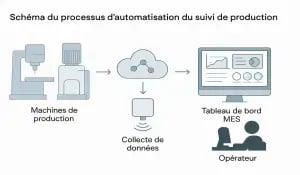
In a context where industrial competitiveness is measured by the minute, manual production monitoring has reached its limits: spreadsheets multiply, entries are delayed, and data reliability is compromised. Automating production monitoring has therefore become a performance catalyst. By combining IoT sensors, MES (Manufacturing Execution System) platforms, and ERP integrations, companies gain real-time visibility of the shop floor, reduce human errors, and transform raw data into actionable insights. Beyond saving time, the objective is strategic: moving from reactive management to proactive control, where every minute of downtime or quality deviation can be detected and addressed before it affects delivery times, costs, and customer satisfaction.
Why Automate Production Monitoring?
Automating production monitoring addresses four key imperatives. First, real-time visibility: a dashboard consolidates machine statuses (running, stopped, in alarm), quantities produced, and scrap rates, allowing bottlenecks to be immediately identified. Second, data reliability: by eliminating re-entry, interpretation errors and end-of-shift omissions disappear. Third, continuous optimization: historical analysis reveals recurring micro-stoppages, slowdowns, or seasonal breakdowns, supporting concrete action plans prioritized by impact and cost. Finally, cost reduction: fewer rejects, fewer unplanned stoppages, and better use of human and material resources.
Setting the Right Objectives and KPIs
Before deploying sensors and connecting machines, it’s essential to define clear objectives. The most common KPIs include OEE (Overall Equipment Effectiveness), availability, performance, quality, utilization rate, mean time between failures (MTBF), and mean time to repair (MTTR). Setting SMART goals (Specific, Measurable, Achievable, Realistic, and Time-bound) ensures that the solution aligns with strategy: reduce downtime by 15%, increase throughput by 8% on a key part, or improve first-pass yield by 3 percentage points.
Equipping Machines with Reliable IoT Sensors
IoT sensors form the foundation of automatic data collection. Depending on the need, machines can be instrumented to monitor running/stopped states, feed rates, spindle temperature, vibration levels, energy consumption, or fluid pressure. These sensors transmit data via standard industrial protocols (OPC UA, Modbus, MQTT). The hardware choice should consider robustness (IP65/IP67), measurement accuracy, latency, calibration ease, and cybersecurity. On heterogeneous equipment, adding edge gateways allows unified signals and local filtering/aggregation to reduce network load.

Connecting the Shop Floor to an MES or MRP Platform
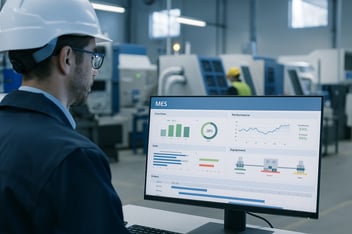
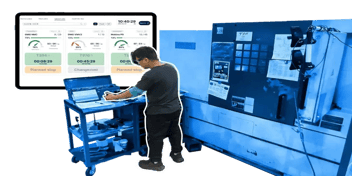
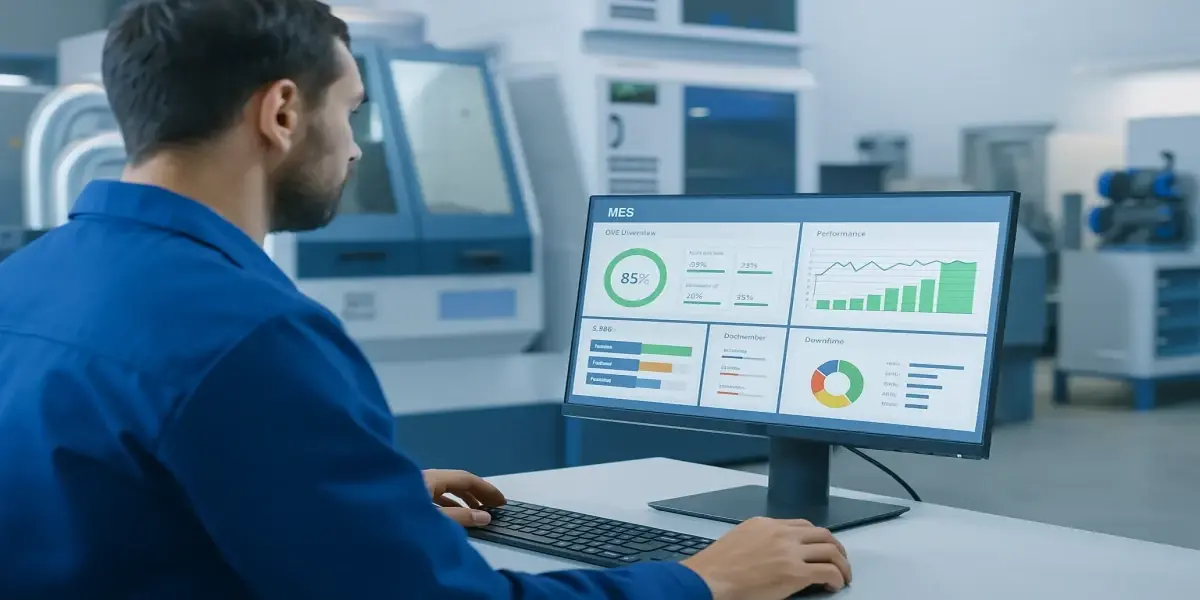
The MES acts as the orchestrator: it centralizes production events, associates data with work orders, operators, and workstations, and provides views by line, team, and period. Best practices include clear modeling of bills of materials and routings, accurate mapping of machine states, and regular synchronization with the ERP for inventory and orders. MRP remains useful for detailed planning, while MES ensures execution and real-time feedback. Ergonomics is crucial: simple screens, consistent color codes, and kiosk modes reduce operator cognitive load and accelerate adoption.
Automating Reporting and Advanced Analytics
Once data is captured, the challenge is to transform it into actionable insights. Dynamic dashboards display real-time KPIs, with configurable thresholds and alerts. On the analytics side, algorithms detect anomalies (cycle drift, energy overconsumption) and suggest correlations: increased rejects when ambient temperature exceeds a threshold, reduced efficiency after a tooling change, etc. PDF or Excel reports can be automatically generated and sent to team leaders and management at the end of each shift, day, or week, ensuring a structured management rhythm.
Condition-Based and Predictive Maintenance
Beyond scheduled preventive maintenance, sensor data enables condition-based maintenance: intervention occurs when a relevant threshold (vibration, temperature, current) is exceeded. Predictive models assess short-term failure risk based on historical patterns. The result: better-planned interventions, shorter downtimes, and improved availability. However, a continuous improvement loop must be established: validate alerts, adjust thresholds, and enrich failure labels to train predictive models.
Change Management and Team Upskilling
Automation is, above all, a human journey. Early communication on objectives, involving operators in screen design, and learning by doing are key success factors. An ambassador program (one champion per team), microlearning capsules, and regular KPI review sessions encourage adoption. Recognizing field-driven improvement ideas (kaizen) strengthens continuous improvement culture and gives meaning to data.
Data Governance, Security, and Compliance
The system’s value depends on reliable, secure, and usable data. Define an indicator dictionary (sources, calculation rules, units), implement integrity controls (anti-duplicates, anti-gaps), and secure data flows (encryption, network segmentation, access management). Documenting parameter changes and applying retention policies ensures compliance with customer and regulatory requirements. Finally, maintain portability: avoid vendor lock-in to preserve future flexibility.
vendor lock-in to preserve future flexibility.
Unlock Your Shop Floor’s Potential
Start automating your machine monitoring and gain real-time production visibility at no cost. Connect up to 5 machines for free and experience the benefits of data-driven manufacturing today.
A well-managed deployment usually follows four phases:
1 – Diagnosis and Scoping: map the equipment, define KPIs, estimate expected ROI, and select the target equipment and platform.
2 – Pilot: instrument 3 to 5 machines, configure screens, conduct initial training, and fine-tune alert thresholds.
3 – Industrialization: extend to the rest of the workshop, standardize report templates, and integrate deeply with ERP and QMS systems.
4 – Continuous Improvement: conduct quarterly reviews of indicators, prioritize improvement projects, and advance toward predictive analytics and energy optimization.
Conclusion: Toward a Smarter, More Agile, and More Sustainable Shop Floor
Production monitoring automation is not just an IT project it’s an operational transformation aligning shop floor, quality, maintenance, and management around a shared data truth. By instrumenting machines, centralizing information through an intuitive MES, and enabling analytics, you gain reactivity, reliability, and competitiveness. The journey expands with predictive maintenance and energy optimization, paving the way for an efficient and sustainable factory. The best time to start is now: begin with a focused pilot, engage your teams, and make data your competitive advantage.