Introduction
OEE (Overall Equipment Effectiveness) is one of the most widely used indicators in the manufacturing industry to measure the real performance of equipment. It is far more than a technical KPI. It reflects your shop’s ability to produce at the right pace, with the right quality level, and without unnecessary interruptions.
In an environment where supply chains are under pressure and every minute of downtime can cost tens or even hundreds of dollars, mastering OEE has become a strategic necessity. Tracking this indicator helps manufacturers improve productivity, reduce operating costs, and increase the reliability of operations.
This comprehensive guide explains how to measure, analyze, and optimize the OEE of your machine tools using a structured, progressive methodology adapted to real shop-floor conditions.
What Is OEE? (Definition, Objectives, and Industrial Stakes)
OEE quantifies the actual effectiveness of a piece of equipment through three dimensions:
- Availability: how long the machine is actually producing.
- Performance: the true production speed compared to the ideal cycle time.
- Quality: the percentage of conforming parts produced.
Together, these three components provide a global and precise view of a machine tool’s effectiveness. Unlike a simple utilization rate or an isolated scrap metric, OEE offers a multidimensional perspective that exposes hidden losses.
Why Is OEE So Important?
Because it reveals critical information that is often invisible in day-to-day operations:
- Downtime no one sees (micro-stops, undocumented operator pauses, slowdowns).
- True speed losses (poor maintenance, worn tooling, inefficient CNC programs).
- Real quality performance (scrap rate, rework, non-conforming parts).
- Differences in performance across operators, shifts, programs, or machines.
A shop may believe it runs at 80% efficiency, when its actual OEE could be closer to 55–60%. OEE highlights this gap between perceived performance and real performance.
The Three Components of OEE (Detailed Explanations + Examples)
1. Availability: Reducing Downtime to Produce More
Availability measures the share of time a machine is truly productive.
It is impacted by factors such as:
- Unplanned breakdowns
- Lengthy setups
- Tool changes
- Operator absence
- Material or tooling shortages
Example
A CNC turning machine scheduled to operate for 8 hours experiences:
- 30 minutes of setup
- 25 minutes of unplanned downtime
- 20 minutes waiting for material
Productive time = 6 h 45
→ Availability = 6.75 ÷ 8 = 84.3%
2. Performance: Producing at the Right Speed
Performance compares actual production speed to the machine’s ideal cycle time.
Key factors influencing performance include:
- Tool wear
- Under-optimized CNC programs
- Fixturing limitations and part complexity
- Slowdowns due to limited operator availability
Example
Ideal rate: 100 parts/hour
Actual rate: 80 to 95 parts/hour depending on conditions
→ Performance = 88–93%
3. Quality: Controlling Scrap and Rework
Quality measures the percentage of good parts produced the first time without scrap or rework.
Primary causes of poor quality include:
- Incorrect cutting parameters
- Material defects
- Poor fixturing
- Human error
- Undetected tool wear
Example
Out of 300 parts:
- 273 are conforming
- 27 are out of tolerance
→ Quality = 91%
Final OEE: Combining the Three Components into One Indicator
Using the previous examples:
- Availability = 84.3%
- Performance = 90%
- Quality = 91%
→ OEE = 0.843 × 0.90 × 0.91
→ OEE ≈ 69%
This example illustrates a common reality: a shop that seems efficient on paper may lose up to 30% of its real productivity.
Step 1: Collect Reliable Data (The Foundation of Accurate OEE)
Accurate OEE depends on reliable, consistent, and complete data.
Here are the three main types of data collection approaches:
1. Automatic Data Collection (Ideal Approach)
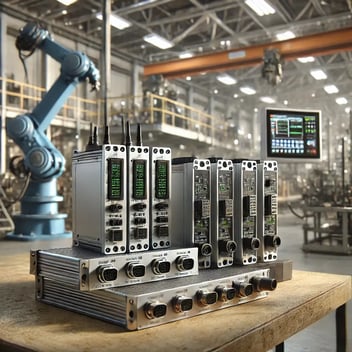
This method uses industrial IoT and connectivity to automatically capture machine states, cycles, and downtime:
- IoT sensors detecting cycle counts and machine states
- Industrial gateways reading electrical signals (24V, Modbus, OPC-UA)
- Direct CNC connectivity (Fanuc, Haas, Mazak, DMG Mori)
Automatic data ensures:
- No missing information
- No manual entry errors
- Real-time visibility
- 100% accurate OEE calculations
2. Semi-Automatic Data Collection
Operators manually complete missing context, such as:
- Tool-break stoppages
- Waiting for material
- Scheduling errors
- Extended quality checks
This is essential for identifying the root causes behind machine downtime.
3. Manual Data Collection (Last Resort)
Using Excel, paper sheets, or tracking cards.
Common but unreliable due to:
- Frequent omissions
- Unreported downtime
- Rounded approximations
- Subjective interpretation
Manual OEE is often overestimated by 10–25%, which can distort improvement decisions.
Step 2: Correctly Calculate OEE (Advanced Industrial Method)
To ensure consistent, comparable OEE calculations:
- Use consistent time windows (shift, day, week).
- Separate planned downtime (breaks, planned maintenance) from unplanned downtime.
- Use the machine’s real ideal cycle time, not an estimated target.
- Include scrap in the quality calculation.
- Apply the same rules across all machines and operations.
This standardization enables fair comparisons between:
- Machines
- Shifts
- CNC programs
- Families of parts
- Year-to-year performance
Step 3: Centralize and Analyze OEE (Transforming Data Into Insights)
OEE analysis relies on good visualization tools.
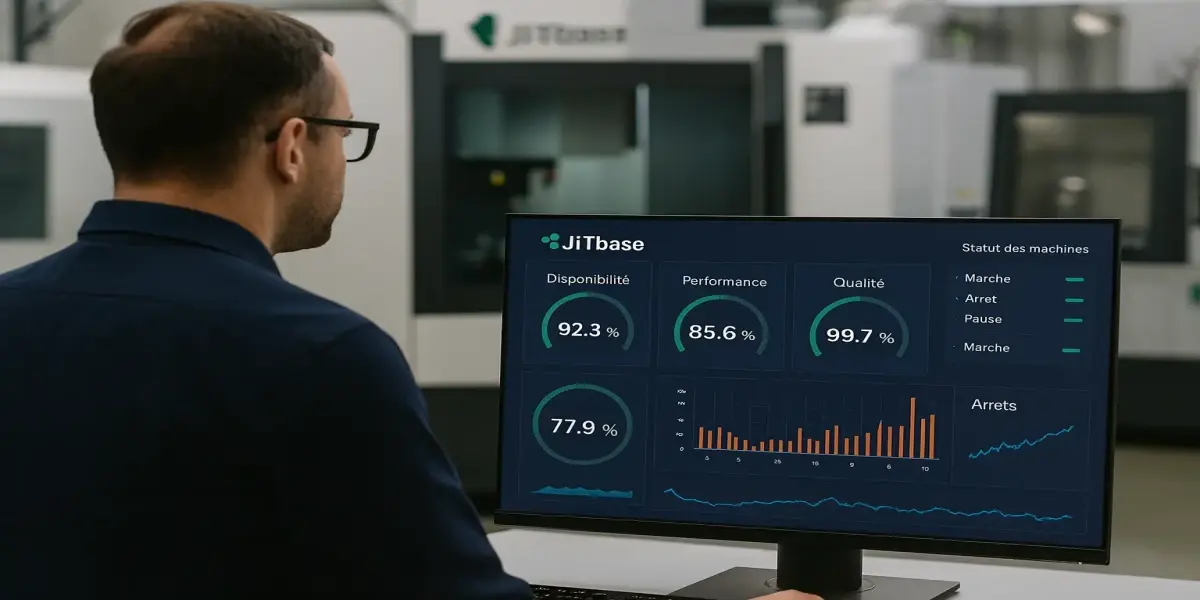
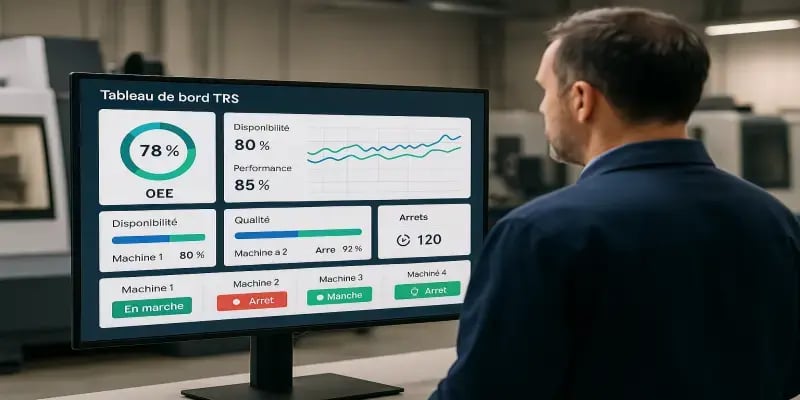
An effective dashboard should provide:
1. Clear Metrics
- OEE per machine
- OEE per shift
- Daily / weekly OEE
- Availability / Performance / Quality breakdown
- Multi-month historical data
2. Visual Trends
Useful graphs include:
- Downtime trends
- Root-cause histograms
- Scrap rate by part family
- Before/after improvement comparisons
- Availability by downtime category
3. Real-Time Alerts
Examples of smart alerts:
- Availability drops below 80%
- Performance falling over a 3-day trend
- Scrap rate above 5%
- Downtime events exceeding 15 minutes
Modern machine monitoring systems detect anomalies instantly and notify supervisors in real time.
Step 4: Identify Losses (Using the 6 Big Losses Framework)
Lean Manufacturing, TPM, and FMEA classify equipment losses into six categories:
- Unplanned breakdowns
- Setup & adjustments
- Micro-stops
- Reduced speed
- Defects & rework
- Waiting time (operator, material, CNC program, etc.)
Mapping these losses helps identify areas where improvements will deliver the highest ROI.

Step 5: Implement Corrective Actions (With Real Examples)
You can improve OEE quickly by focusing on high-impact actions such as:
- Implementing SMED to reduce setup times
- Optimizing tooling and tool life strategy
- Improving scheduling clarity
- Automating OEE data collection
- Standardizing CNC programs
- Training operators on best practices
- Introducing TPM routines.
Real Improvement Example
Before improvement:
Setup time for a program change = 22 minutes
After SMED + modular tooling:
Setup time reduced to 7 minutes
→ Availability +5%
→ OEE +3 points
A simple, targeted action can produce significant gains.
Step 6: Monitor Long-Term Progress (Continuous Improvement Program)
OEE should be monitored:
- Daily (to detect anomalies fast)
- Weekly (to guide team performance)
- Monthly (to plan investments and process improvements)
Industry OEE Benchmarks
- < 50% : highly inefficient operation
- 50–65% : major improvement potential
- 65–75% : acceptable
- 75–85% : excellent
- 85% : exceptional (rare in machining)
Consistent analysis transforms OEE into a strategic management tool.
Recommended Digital Tools for Accurate OEE
1. MES / CAPM Systems
- Automatic data collection
- OEE analysis
- Downtime categorization
- Consolidated reporting
2. Industrial IoT Solutions
- Fast CNC connectivity
- Automatic state detection
- Cycle time measurement
3. Real-Time OEE Dashboards
- Instant visibility
- Simple visualization
- Smart notifications
These digital tools eliminate human error and provide 100% reliable OEE.
Boost your OEE and unlock a fully connected, optimized production environment.
Conclusion
OEE is a foundational indicator for understanding the true performance of your machine tools.
By combining:
- reliable data collection,
- structured analysis,
- targeted corrective actions,
- and ongoing monitoring,
you can significantly increase productivity, reduce losses, and strengthen your shop’s profitability.
Thanks to modern IoT and MES/CAPM solutions, tracking and optimizing OEE has never been easier or more essential to staying competitive.