
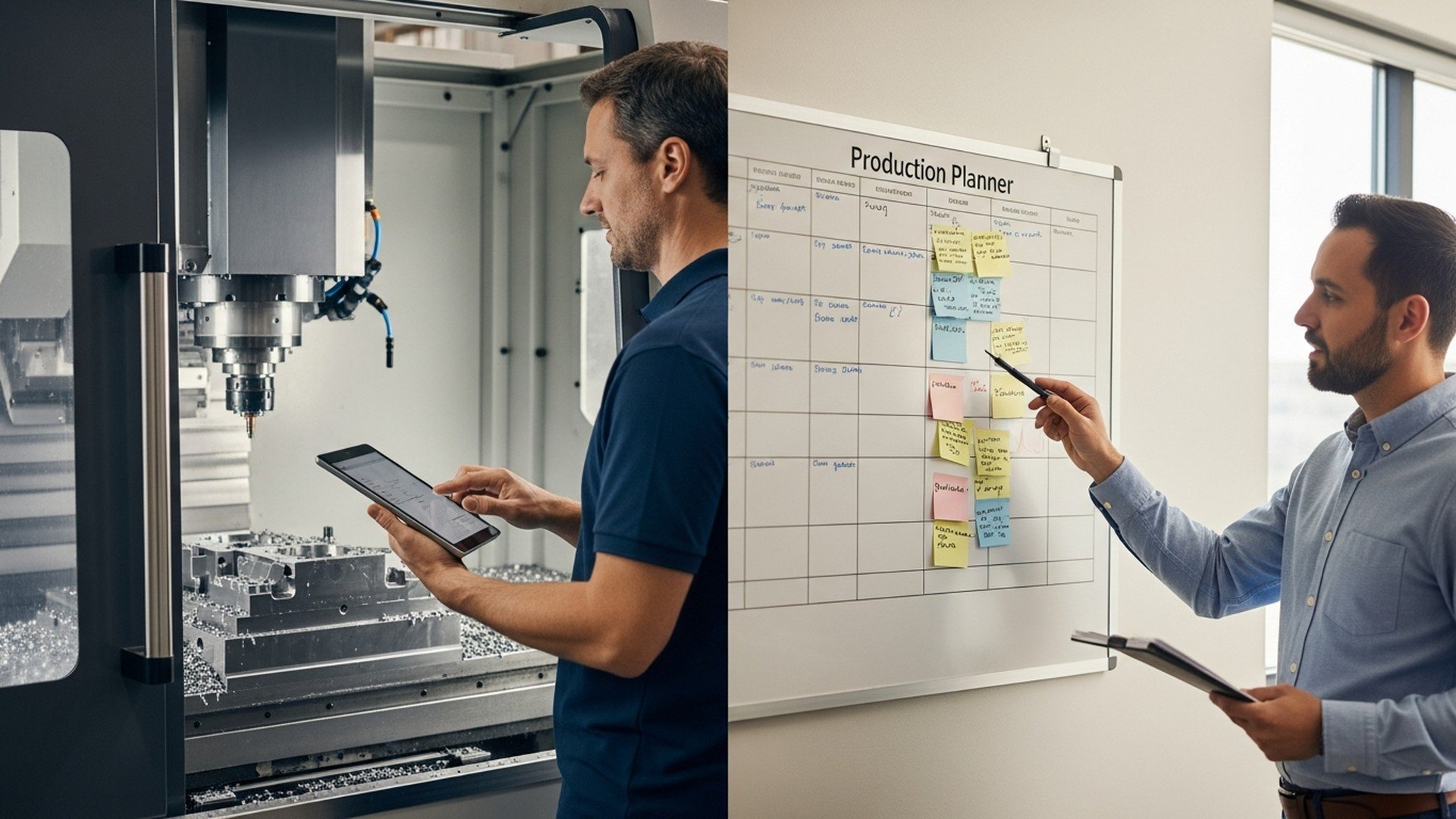
Small-to-medium CNC shops face a familiar set of problems: constrained capacity, inaccurate cycle times, and OEE reported from spreadsheets. This article compares mes vs erp directly for those shops and explains what each system changes, how quickly you can expect results, and which path usually delivers the fastest throughput gains without hiring. Readers will learn practical decision criteria, pilot checklists, cost and timeline ranges, and specific integration patterns for real-time labor and OEE reporting.
TL;DR:
-
Choose MES-first if immediate shop-floor visibility and accurate cycle times are priority — expect measurable OEE and throughput improvements in 4–12 weeks on a pilot cell.
-
Choose ERP-first if invoicing, purchasing, costing, or compliance block business operations now; add a lightweight MES connector later.
-
Choose integrated MES+ERP (best-of-breed) when you need both operational accuracy and enterprise controls; plan 3–9 months and map work orders, serials, and inventory events.
Industry research shows accelerating digital adoption in manufacturing; see a practical comparison of MES and ERP features and trade-offs in this overview of MES vs ERP for additional context.
MES vs ERP: Which is Better in 2026? — Quick Comparison Table
| Criteria | MES | Traditional ERP | Cloud ERP | Integrated MES+ERP |
|---|---|---|---|---|
| Primary objective | Improve shop-floor visibility, OEE, cycle times | Centralize finance, purchasing, order-to-cash | Same as ERP with faster updates and SaaS ops | Combine shop-floor truth with financials |
| Key metrics improved | OEE, downtime minutes, cycle-time accuracy | Inventory accuracy, AR days, PO cycle time | Inventory, cash flow, deployment speed | OEE + cost-to-serve, schedule attainment |
| Typical time-to-value | Weeks to 3 months (pilot → cell roll-out) | 3–12 months (process and chart of accounts) | 1–6 months (modular setup faster) | 3–9 months (phased integration) |
| Typical cost range | Low–medium (software + edge devices + install) | Medium–high (licensing + config) | Medium (subscription, connectors) | Medium–high (both systems + integration) |
| Implementation complexity | Low–medium (machine connectivity needed) | Medium–high (process redesign) | Medium (depends on connectors) | High (mapping, middleware, testing) |
| Best initial ROI | Bottleneck throughput and labor minutes | Billing accuracy and procurement savings | Shops with small IT teams and OpEx budgets | Businesses needing accurate costing + OEE |
How to read this table: time-to-value reflects pilot-first approaches. For small CNC shops, expected throughput gains vary: targeted MES pilots typically show +5–30% throughput where manual tracking and inaccurate cycle times were the constraint. Standards like ISA-95 and connectivity technologies such as OPC-UA and MTConnect are common patterns for integration.
MES vs ERP: Which is Better in 2026? — Option 1: Manufacturing Execution Systems (MES)
Overview: What Modern MES Does for CNC Shops
A manufacturing execution system (MES) sits at the shop floor level to collect machine signals, track jobs, and enforce routing and quality tasks. For CNC shops, a modern MES usually includes automatic cycle-time extraction from programs, real-time part counts, operator job cards, tool-life tracking, and OEE dashboards. It bridges programmable logic controllers (PLCs), CNC controllers, and edge gateways to deliver second-to-minute latency for production events.
MES is the short route to accurate shop-floor data. It captures when a machine runs, when parts are completed, and when operators intervene — often through OPC-UA or MTConnect-enabled connections and low-cost edge devices for older controls. These signals let operations calculate standard times from the program and compare planned vs actual automatically.
Strengths: Real-time OEE, Automatic Cycle Times, Operator Workload Tracking
-
Immediate visibility: Real-time dashboards show machine state, downtime reasons, and throughput per operator. This reduces manual data collection.
-
Accurate cycle times: MES can extract cycle times from G-code or CNC programs and validate them with spindle/load signals; see techniques in cycle time from CNC and the g-code workflow.
-
Labor accounting at the cell: Operator start/stop events and job assignments produce accurate labor minutes per part without spreadsheet entry.
-
Reduced manual touchpoints: Automated OEE reporting and event capture remove daily clerical tasks; implementation playbooks exist for automating monitoring: monitoring playbook and automate production monitoring.
Weaknesses: Limited Financial Functions, Integration Needs
MES does not replace accounting, payroll, or billing systems. It often needs mappings to ERP fields (work orders, part numbers, inventory depletion). If integration is missing, shops risk duplicate data entry or reconciliation overhead. Also, older MES offerings can require custom adapters for legacy CNC controls.
Best For: Immediate Shop-floor Visibility and Throughput Gains
Choose MES-first when the bottleneck is inaccurate cycle times, opaque machine uptime, or heavy manual OEE reporting. Typical pilot scope: one bottleneck cell, extract cycle times, validate with part counts, and publish an OEE dashboard. Evaluate vendor features using the machine monitoring tools and shop-floor software roundups.
MES vs ERP: Which is Better in 2026? — Option 2: Traditional ERP Systems
Overview: What ERP Covers for a Manufacturing Shop
Enterprise resource planning (ERP) consolidates finance, purchasing, inventory valuation, order management, and high-level production planning. For many shops, ERP is the system of record for costing, invoicing, and compliance. Traditional on-prem ERP implementations come with extensive configuration for chart of accounts, costing methods, and procurement workflows.
ERP is essential for clean accounting and accurate inventory valuation. But it typically lacks deep, real-time hooks into CNC controls and may only accept manual updates from spreadsheets or barcode scans.
Strengths: Financials, Purchasing, Inventory Valuation, Billing
-
Accounting rigor: Accurate cost-of-goods-sold, AP/AR automation, tax and compliance workflows.
-
Procurement efficiency: Better reorder planning, vendor management, and purchase order controls reduce stockouts and expedite lead times.
-
End-to-end order processing: Invoicing and billing are centralized, improving cash flow and month-end close.
Weaknesses: Weak Shop-floor Visibility, Manual Labor Tracking
ERP systems often treat production as high-level planned capacity rather than real-time events. They rarely extract cycle or standard times from CNC programs automatically, so labor and machine-time remain estimates unless integrated with an MES. That gap leads to double data entry or reconciliations during month-end.
ERP-first makes sense when billing, costing accuracy, or compliance is the dominant pain. When shop-floor detail is required, ERP implementations usually add modules or connectors. For approaches to sync labor and OEE into ERP, see real-time labor tracking. Workforce planning comparisons can help pick complementary tools: workforce planning tools.
Best For: Shops That Need Accounting and Order-to-cash Consolidation First
Choose ERP-first when financial controls, auditability, or invoicing accuracy are immediate blockers to growth. Example: a contract shop that loses bids due to inconsistent costing or that fails compliance audits should consolidate ERP processes before expanding shop-floor visibility.
MES vs ERP: Which is Better in 2026? — Option 3: Modern Cloud ERP and Modular Platforms
Overview: Cloud ERP Evolution and Modularity
Cloud ERP vendors now offer modular architectures and public APIs that reduce deployment time and IT burden. Many provide marketplace add-ons or prebuilt connectors for shop-floor data, so small manufacturers can subscribe to an ERP and add shop connectors as needed.
Strengths: Faster Deployments, Saas Updates, Integrated Add-ons
-
Quicker onboarding: SaaS deployment removes provisioning delays; smaller vendors can go live in weeks for basic modules.
-
Lower IT overhead: The vendor handles updates, backups, and security, which suits shops with limited IT staff.
-
Modular add-ons: Marketplaces often host time-tracking, MES connectors, and advanced planning modules, reducing custom work.
Weaknesses: Data Residency, Subscription Costs, May Still Lack Deep Shop-floor Hooks
Cloud ERPs still may need edge gateways or third-party MES for machine-level telemetry. Subscription costs accumulate over time, and some shops require on-premise controls for regulated work. Data residency and latency can be concerns for high-volume telemetry.
Best For: Shops Wanting Lower It Overhead and Phased Rollouts
Cloud ERP is a good choice for shops that prioritize procurement, payroll, and vendor management but want an incremental approach to shop-floor integration. For high-mix environments, evaluate connectors to capacity planning platforms and advanced planning tools to gauge readiness.
MES vs ERP: Which is Better in 2026? — Option 4: Integrated MES + ERP (best-of-breed Integration)
Overview: How Integration Closes Gaps
Integrating MES with ERP maps real-time shop-floor events into enterprise financial and planning workflows. Typical integration points: work order creation from ERP, route and resource definitions synced to MES, part completions posted back to ERP for inventory and costing, and labor events for payroll costing. Many integrations follow ISA-95 mapping patterns and use middleware or API-first connectors.
This video explains the fundamentals:
Strengths: Best of Both Worlds — Accurate Shop-floor Data Feeding Financials
-
Accurate costing: Machine hours and real labor minutes flow into cost models automatically.
-
Inventory accuracy: Consumption events from MES reduce reconciliation and shrinkage.
-
Real-time scheduling: ERP planners receive live progress updates and can reschedule dynamically.
Weaknesses: Integration Complexity, Vendor Coordination
Integration requires data governance, unique identifiers (work order numbers, serials), and testing across systems. Projects can stall when responsibilities are unclear between MES and ERP vendors. Middleware adds costs and introduces another system to support.
Best For: Shops Needing Both Operational Visibility and Enterprise Controls
Best-of-breed integration is the right approach when both accurate operational data and financial controls are business-critical. Start with low-lift mappings: sync open work orders to MES and post completed quantities back to ERP. For planning an integration, use the shop-floor checklist and apply the monitoring playbook for implementation steps. Track post-integration KPIs like OEE, schedule attainment, and labor minutes per part.
MES vs ERP: Which is Better in 2026? — Implementation Risks, Timelines, and Cost Drivers
Typical Project Stages and Time-to-value
-
Proof-of-concept (4–8 weeks): Connect one machine or cell, validate cycle-time extraction, and publish OEE. Use an edge device and one MES dashboard.
-
Pilot (8–12 weeks): Extend to the full bottleneck cell, include operator workflows, and map one ERP field (work order).
-
Rollout (3–12 months): Phased expansion by area or product family, full ERP mappings, and training.
Pilots deliver early wins: extracting cycle times and validating part counts will often show where scheduling changes produce immediate throughput increases. See the extract cycle times guide for procedures to establish accurate standards.
Common Failure Modes and How to Avoid Them
-
Unclear data ownership: If operations and accounting don't agree on keys and metrics, integration stalls. Assign data stewards early.
-
Poor cycle-time accuracy: Relying on operator estimates produces noisy KPIs. Use program-derived cycle times and validate with sensors.
-
Skipping operator change management: Operators must see value (less paperwork, clearer job instructions) or adoption will be low.
Mitigation: start small, instrument the bottleneck, and demonstrate measurable labor or uptime gains before scaling.
Budgeting: Where Costs Come From (software, Integration, Process Change)
-
Software: MES licenses, ERP modules, or middleware subscriptions.
-
Hardware: Edge gateways, PLC/CNC adapters, and networking.
-
Integration: Mapping, API work, and testing (often the largest variable).
-
Change management: Training and process documentation.
A conservative budgeting approach is to allocate 40–60% of project cost to integration and testing, 20–30% to software, and 10–20% to hardware and training. Use KPI dashboards to prove ROI quickly; see KPI dashboards for recommended visualizations.
MES vs ERP: Which is Better in 2026? — Which Should You Choose? Scenario-based Recommendations
Scenario A: You Need Throughput Now and Can't Hire
Recommendation: MES-first pilot on your primary bottleneck. Measure cycle-time accuracy, operator minutes per part, and scrap. Deploy an edge device to extract cycle times from G-code and validate counts for 4–8 weeks. See operator-focused tactics in operator productivity tips and reduce non-productive time by improving scheduling using principles from reduce setup time. Expected benefits: faster schedule attainment, OEE uplift, and documented labor savings.
Scenario B: Your Pain is Accounting, Invoicing, and Inventory Accuracy
Recommendation: ERP-first (cloud ERP if lower IT capacity) to stabilize AR, PO, and costing. Add a simple data-capture layer (barcode/scan) for shop completions, then plan MES integration in phase two to improve cycle-time fidelity.
Scenario C: You Have Both Pains but Limited Budget
Recommendation: Start with lightweight integration — an edge gateway that sends validated part completions and labor events into ERP, or a narrow-scope MES that only handles cycle-time extraction and posts counts to ERP. This phased approach balances cash flow and shows value quickly.
Decision Checklist: 6 Quick Diagnostic Questions
-
Do you have live machine data today? (yes/no)
-
Are cycle times captured automatically from programs? (yes/no)
-
Is billing accuracy a business constraint? (yes/no)
-
Can you run a pilot on a single cell? (yes/no)
-
Do you have a designated data steward for integration? (yes/no)
-
Is IT capacity limited (favor cloud)? (yes/no)
Short next steps:
-
If most answers are no and throughput is the constraint: scope an MES pilot for a bottleneck cell; aim to measure OEE improvement and labor minutes per part.
-
If billing and inventory cause loss: scope an ERP module rollout and include a plan to accept simple production events.
-
If mixed: scope a one-month technical spike to sync work orders and post completions, then expand.
MES vs ERP: Which is Better in 2026? — Tools, Checklists, and Next Steps for Pilots
Pilot Scope Template (what to Measure in First 30–90 Days)
-
Pilot objective: Validate cycle-time extraction and part counts for one bottleneck CNC.
-
Metrics: baseline OEE, cycle-time variance, operator minutes per part, scrap rate.
-
Deliverables: one OEE dashboard, automated part-counting, documented SOP for data capture.
Checklist: Data Points to Capture From Machines and People
-
Machine state (run, idle, fault)
-
Spindle load or cycle signal for cycle detection
-
Part completed event (probe or counter)
-
Operator start/stop events and job assignments
-
Tool changes and tool life counters
-
Scrap counts and reason codes
-
Work order ID and part serial (if used)
-
Inventory withdrawal events for consumables
-
Timestamped logs for all events
-
Baseline manual times for comparison
Capture this list when planning a pilot and reference the shop-floor checklist and the automate production monitoring guide for implementation details.
Quick ROI Formula to Justify a Pilot
Estimated monthly benefit = (Time saved per shift shifts per month * hourly labor rate) + (Reduced scrap value) + (Increased throughput * margin per part) Payback months = Pilot cost / Estimated monthly benefit
Example: Save 1 hour/day across 2 shifts at $25/hr = $1,250/month. If increased throughput yields an extra $3,000 margin monthly and pilot costs $8,000, payback = 1.9 months.
The Bottom Line
mes vs erp is not an either-or choice for most small CNC shops: MES delivers the fastest path to measurable throughput and OEE gains, while ERP secures financial accuracy and procurement control. When both are needed, plan a phased integration that starts with a pilot on a bottleneck cell and maps a small set of fields back to ERP.
Frequently Asked Questions
Can I get MES features without replacing my ERP?
Yes. Many shops add a lightweight MES or edge gateway to capture machine events, cycle times, and operator actions while keeping their existing ERP. The key is mapping work order IDs and part numbers so completions and labor post to ERP automatically, avoiding double entry.
Start with a single-cell pilot to validate the data flow before wider rollout.
How long before MES delivers measurable throughput gains?
Results commonly appear in 4–12 weeks on a focused pilot. Early wins come from accurate cycle times, reduced manual reporting, and targeted schedule changes. Document baseline OEE and track improvements with dashboards for quick validation; see recommended dashboards in KPI dashboards.
Will integrating MES and ERP require replacing one vendor?
Not usually. Most modern MES and ERP vendors provide APIs or support middleware. The main work is data mapping (work orders, serials, cost centers). Use a phased, API-first integration approach to reduce risk and avoid rip-and-replace.
Which key KPIs should I monitor during a pilot?
Track OEE, cycle-time accuracy (program vs actual), schedule attainment, labor minutes per part, and scrap rate. These metrics demonstrate operational and financial impact quickly and support business cases for expansion.
Is cloud or on-premise better for small CNC shops?
Cloud ERP or MES is often better for shops with limited IT staff due to faster setup and predictable OpEx. However, on-premise may be required for strict data residency or ultra-low latency needs. Evaluate connectivity, compliance, and total cost of ownership before deciding.
External sources and standards referenced above include the ISA-95 guidance for system integration and connectivity technologies such as OPC-UA (see the OPC Foundation) and MTConnect for machine-level telemetry. For additional reading on connectivity and standards, consult the ISA resource library, MTConnect mtconnect.org, and OPC Foundation materials. For broader industry context on digital manufacturing adoption and expected benefits, see McKinsey's manufacturing insights and NIST's Smart Manufacturing resources.
Related Articles